10-Year Horizon Report Identifies More than 12,600 Miles of Projects to Respond to Changing Needs of Western Grid
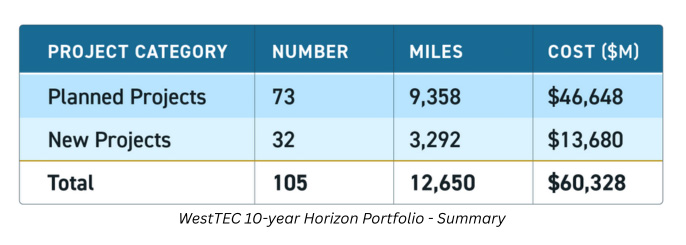
PORTLAND, Ore. – The West needs more than 12,600 miles of high-voltage transmission additions or upgrades to meet the region’s forecasted energy needs by 2035, according to the results of the Western Transmission Expansion Coalition (WestTEC) 10-Year Horizon Study, released today.
The 10-Year Horizon Study took a holistic view of the needs of the West to identify actionable transmission projects that help meet growing demand, integrate new resources and strengthen reliability. Of the projects identified, about two-thirds are already planned or in progress. Timely completion of these projects is essential, or the gap of needed transmission will grow, and reliability challenges will be exacerbated, the study says.
On top of the planned projects, the study identified about 3,300 miles of additional upgrades needed to support reliability, enhance the ability to deliver resources between regions and improve economic efficiency of the grid.
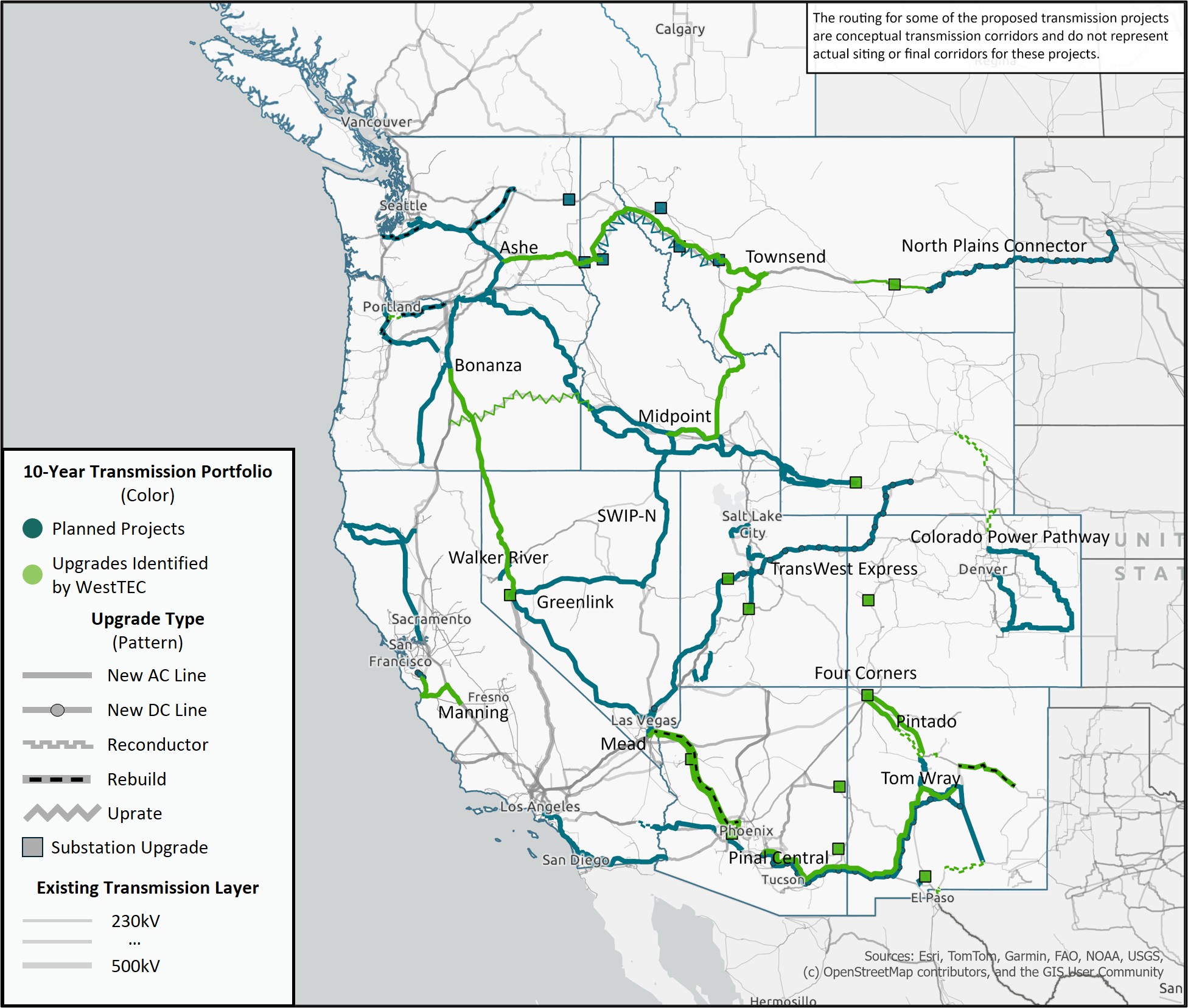
> View the WestTEC 10-Year Horizon Transmission Portfolio Map
“The West is experiencing unprecedented load growth, seeing new resources added at historical rates and is becoming increasingly dependent on the transfer of power between regions during times of need,” said Keegan Moyer, Principal of Energy Strategies, who led the study. “The bottom line is that the pace of interregional transmission expansion has not kept up with these drivers.”
WestTEC launched in late 2023 to fill this critical interregional transmission planning gap. Facilitated by the Western Power Pool, WestTEC brought together more than 70 regional partners from across industry sectors, including electric utilities, state representatives, transmission developers, consumer advocates, environmental advocates, Native American Tribes, industrial customers and technical experts.
“With the breadth and diversity of participants, we’ve built a transparent and inclusive process that adds to the credibility of the study results,” said Sarah Edmonds, President and CEO of Western Power Pool. “Our goal when creating WestTEC was to create actionable recommendations that lead to projects being built. This study provides the data-driven foundation for developers and states to bring these projects to fruition.”
The WestTEC study team built a reference case based on utility resource plans and best available data on load, resource and transmission forecasts. They then conducted assessments and identified transmission solutions that solve reliability issues, enhance regional connectivity and relieve uneconomic constraints.
“The Western grid is increasingly operating as an integrated network, especially during extreme weather events or other stressed conditions where one region must rely on other regions to keep the lights on,” said Crystal Ball, Executive Director of the Pacific Northwest Utilities Conference Committee and a member of the WestTEC Steering Committee. “Recognizing this, WestTEC is advancing a shared vision for a resilient, efficient and future-ready grid where interregional transmission enables all Western communities to access reliable and affordable electricity.”
The portfolio recommended in the study positions the West to integrate new loads, connect new generation and support reliability and affordability through 2035.
“With the pace and magnitude of changes on the Western grid, it’s more important now than ever to look at transmission expansion and how that can help support reliability going forward,” said Branden Sudduth, Vice President of Reliability Planning and Performance Analysis for the Western Electricity Coordinating Council, a major sponsor of the project. “The solutions identified in the study can help the West accommodate an expected 30% growth in electricity demand.”
The portfolio of projects represents an estimated $60 billion in capital investment. The report concludes that these costs are manageable when taken in context, noting that the annualized cost of the projects is eight times less than the cost of the generation capacity that must be added over the same time period and represents only 2.5% of today’s average retail electric price in the West.
The 10-year horizon portfolio provides a transmission blueprint for how the West can sustain reliability, affordability, and support economic growth while progressing on state policy goals. Significant development, regulatory and financing challenges remain for the projects identified, but, the study notes, coordinated action among Western States, utilities, developers and regional partners can materially improve outcomes.
“Moving forward, the conversation must quickly turn to how we can all work together to follow through on developing multiple transmission solutions to meet the clear needs identified by the study,” said Jeff Wood, Chief Commercial Officer of PowerBridge, the lead developer of the 1,100-MW Cascade Transmission Project. “It requires numerous stakeholders to reach consensus and execute actionable solutions on an accelerated time frame. This won’t be easy, but it can be done, ensuring that a reliable and efficient grid will be realized by 2035.”
Work continues on the WestTEC 20-Year Horizon Study, which is expected later in 2026. The transmission portfolio identified in the 10-year study may be adjusted based on what is learned in the 20-year analysis.
About WestTEC: The Western Transmission Expansion Coalition, facilitated by the Western Power Pool, is a West-wide effort to develop an actionable transmission plan to support the needs of the future energy grid. WestTEC is committed to a new approach to transmission planning through the main themes of being different, inclusive, expedient and transparent.
Media contact: For more information, contact Kevin Langbaum at kevin@kblcommunications.com.